Ventilation
Attic and roof ventilation for Atlanta homes
An attic that cannot breathe cooks the shingles from below in summer and holds moisture in winter. Balanced intake and exhaust fixes both, and it is often a small job.
- Calls answered 24/7
- Ridge, soffit and attic fans
- Atlanta service office
Quick answer
Attic ventilation in Atlanta works by drawing cooler air in at the soffits and letting hot, moist air out at the ridge, with intake and exhaust balanced so neither side is starved. Blocked soffits, mixed exhaust types and undersized ridge vents are the usual faults. We check the attic, fix the balance, and close vents that short-circuit the flow.
The work
What poor ventilation does to a roof
In summer, an unvented attic runs far hotter than the air outside, and that heat bakes the shingles from underneath and loads the air conditioner. In cooler months, warm indoor air carries moisture into the attic, where it condenses on the cold deck and nails, darkening the plywood and rusting fasteners.
The fix is balance, not more vents. Two kinds of exhaust on one roof, like a ridge vent plus gable fans, can pull air from each other instead of from the soffits.
Updated September 2026
We install shingle, metal and membrane systems from GAF, Owens Corning, CertainTeed, Carlisle and Firestone.
Options
Attic exhaust options compared
| Factor | Ridge vent | Box vents | Powered or solar fan |
|---|---|---|---|
| How it works | Continuous slot along the peak | Individual vents near the ridge | Fan pulls air out |
| Best with | Continuous soffit intake | Roofs without a usable ridge | Specific heat problems |
| Watch for | Needs enough ridge length | Uneven airflow | Can pull air from the house |
| Upkeep | None | Check seals and caps | Motor or panel can fail |
Mixing exhaust types on one roof usually hurts airflow, so we pick one and close the rest.
Cost
What ventilation work costs depends on
Most ventilation fixes are small jobs; the price follows how much roof and soffit has to be opened.
- Ridge length
Linear feet of vent and cap shingles.
- Soffit condition
Blocked or solid panels replaced.
- Baffles
Installed where insulation blocks the airway.
- Old vents to close
Box vents or fans removed and patched.
- Roof access
Steep or tall roofs need more rigging.
- Timing
Least cost when done with a replacement.
Ridge vent installation
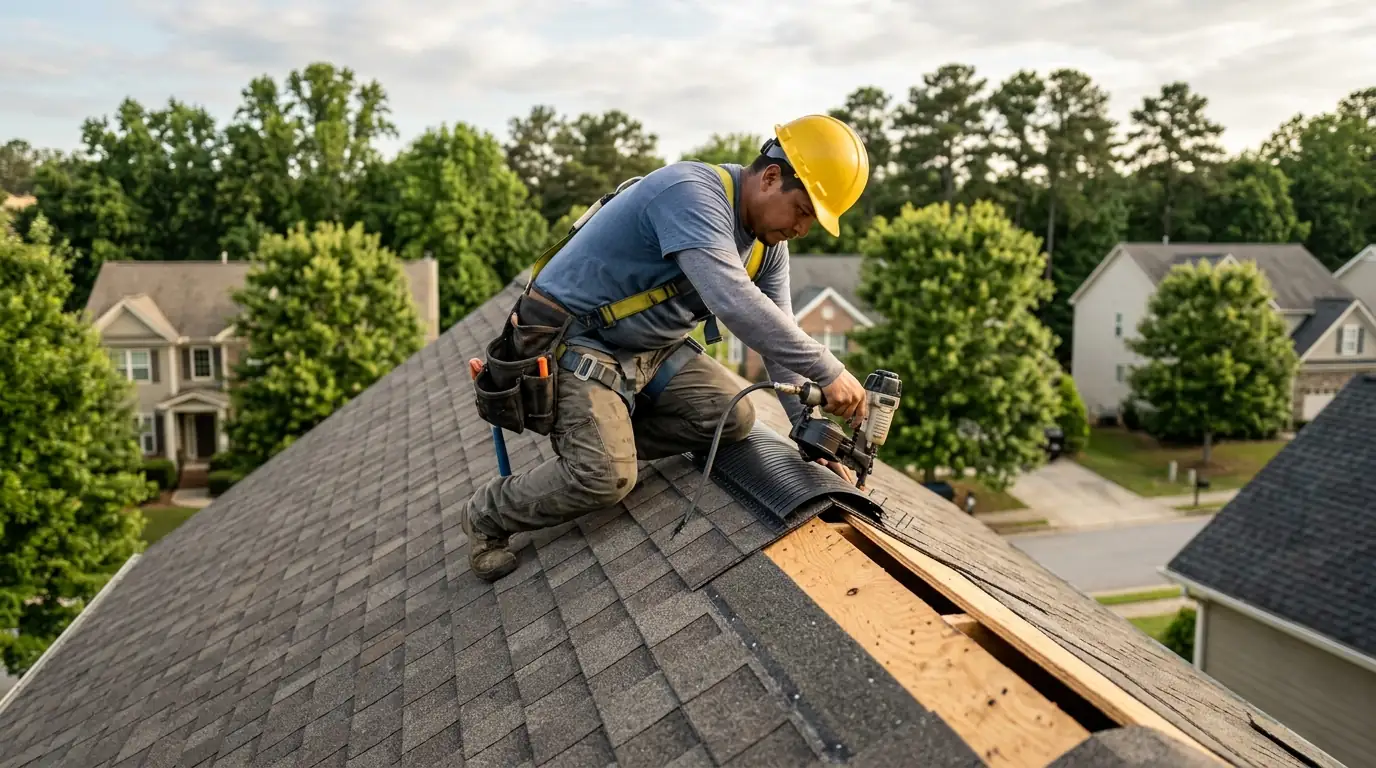
A ridge vent runs along the peak under the cap shingles, letting hot air leave evenly along the whole attic. The deck is cut back on both sides of the ridge, the vent is fastened over the slot, and cap shingles go over the top. Baffled vents keep rain and insects out while air flows through. We size the opening to the attic and make sure the ridge is long enough to do the job; on hip roofs with short ridges, other exhaust may work better.
Soffit intake vents
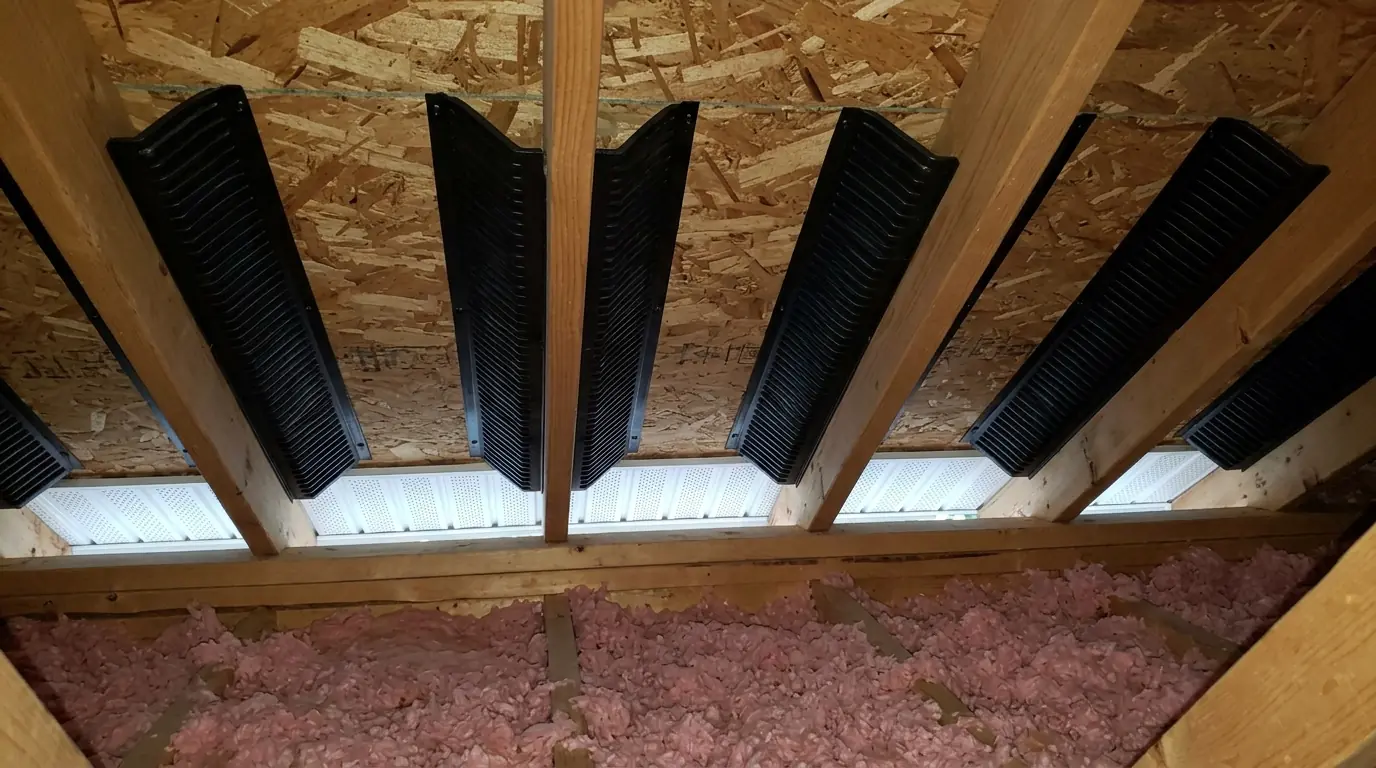
Exhaust only works if cool air can come in low, and soffit intake is where most ventilation systems fail. Paint, blown-in insulation and solid soffit panels all block it. We open or replace soffit panels with vented ones, install baffles between the rafters so insulation cannot slump into the airway, and confirm air actually reaches the attic space. On homes with little or no overhang, edge intake vents installed along the lower edge of the roof can supply the same air.
Powered and solar attic fans
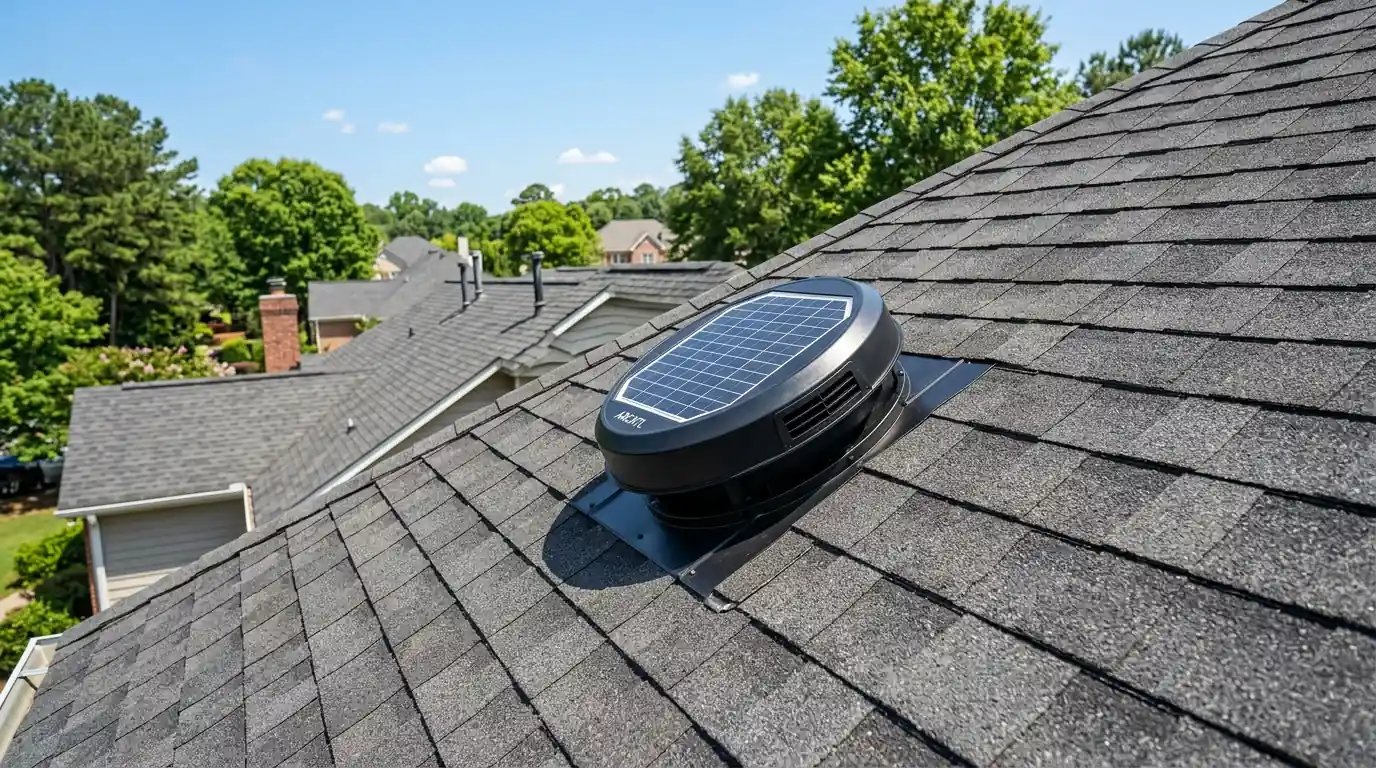
Attic fans pull air out mechanically, and they can help a stubborn attic, but they can also backfire. If intake is weak, a fan pulls air from wherever it can, including conditioned air from the house through ceiling gaps and light fixtures. We only recommend a fan when intake is adequate and a ridge vent is not practical, and we never pair one with a ridge vent on the same attic. Solar models avoid wiring but move less air on cloudy days.
Heat, attics and re-roofing in Atlanta
On a summer afternoon, intown Atlanta can run up to 15 degrees Fahrenheit warmer than the city's leafiest areas, and an attic under a dark roof there soaks up that heat first. Re-roofing is the natural time to fix ventilation: the code can trigger ventilation and insulation checks on a re-roof, and the deck is already open at the ridge, so a correction made during a replacement costs far less than the same work done later on its own.
How it runs
How a ventilation fix runs
- 1
Attic inspection
Heat, moisture, insulation and vents checked.
- 2
Measure the balance
Intake and exhaust compared to attic size.
- 3
Written plan
What to add, open or close, and why.
- 4
Open the intake
Soffits vented, baffles installed.
- 5
Set the exhaust
Ridge vent cut in or a fan fitted.
- 6
Close the extras
Competing vents removed and patched.
Warning signs
Signs the attic is not breathing
Upstairs much hotter
Heat radiating down from the attic.
Frost or damp on nails
Moisture condensing in cool weather.
Dark or stained decking
Moisture on the underside of the deck.
Shingles aging early
Curling or granule loss on a young roof.
Painted-over soffits
Intake blocked by paint or insulation.
Musty attic smell
Moisture trapped with nowhere to go.
FAQ
Attic ventilation questions
Hot upstairs rooms, damp or frosty nails in cold weather, dark decking and shingles aging early are the common signs.
Too much exhaust without matching intake can pull conditioned air from the house. Balance matters more than quantity.
Only if intake is adequate and a ridge vent will not work. A fan paired with a ridge vent short-circuits the airflow.
It reduces attic heat, which helps, but insulation and air sealing usually matter more for the bill.
Yes. Ridge vents, soffit vents and baffles can all be added to an existing roof.
Alongside a ridge vent, gable vents act as a shortcut, so air enters at the gable instead of the soffits.
Related
Roof work that affects ventilation
Hot attic, hot upstairs?
Call and we will check the attic and tell you exactly what the ventilation needs.