Gutter guards
Gutter guard installation for Atlanta homes under trees
Guards don't make gutters maintenance-free, but the right guard on the right house turns seasonal cleanouts into an occasional rinse. The trick is matching the guard to what falls from your trees.
- Calls answered 24/7
- Matched to your trees
- Atlanta service office
Quick answer
Gutter guards in Atlanta work best when matched to the debris: fine micro-mesh stops pine needles and seed pods, while screens and perforated covers handle broad leaves at a lower cost. We clean and repair the gutters first, correct their pitch, and fasten guards so they sit under the shingle edge without lifting it. Guards still need an occasional rinse.
The work
Why guards fail when they are mismatched
Most disappointing gutter guards were simply the wrong guard for the trees. Pine needles slip through coarse screens and wedge in them; oak tassels and seed pods mat on top of solid covers; cheap snap-in screens sag and blow off. Guards also fail when they go on dirty, sagging or badly pitched gutters.
So the job starts with the gutters themselves, then the guard that suits what actually falls on your roof.
Updated September 2026
Options
Choosing a gutter guard
| Factor | Micro-mesh | Screen or perforated | Reverse-curve |
|---|---|---|---|
| Stops | Pine needles, seeds, leaves | Broad leaves | Most leaves |
| Upkeep | Occasional brushing or rinse | Clear debris off the top | Clean the lip and inlet |
| Heavy rain | Handles most downpours | Handles most downpours | Can overshoot in the heaviest rain |
| Cost position | Highest | Lowest | Middle to high |
Under pines, micro-mesh is usually the only guard worth the money; under hardwoods, a rigid screen often does the job.
Cost
What gutter guards cost depends on
Guards are priced by the linear foot, and the guard type and the gutters' condition set most of the number.
- Linear footage
Total length of gutter runs.
- Guard type
Mesh costs more than screens.
- Gutter repairs
Hangers, leaks and pitch fixed first.
- Stories
Second-story runs need more rigging.
- Roof edge
Tile or metal edges fasten differently.
- Downspouts
Flushing and outlet screens.
What is included
What a gutter guard installation includes
- Gutters cleaned. Troughs emptied and downspouts flushed.
- Repairs first. Loose hangers, leaks and sags fixed.
- Pitch checked. Runs sloped so water reaches the outlets.
- Guards fitted. Cut and fastened to each run.
- Roof edge protected. Guards set without lifting shingles.
- Corners and outlets. Detailed where debris collects.
- Water test. Hose run to confirm the flow.
Micro-mesh gutter guards
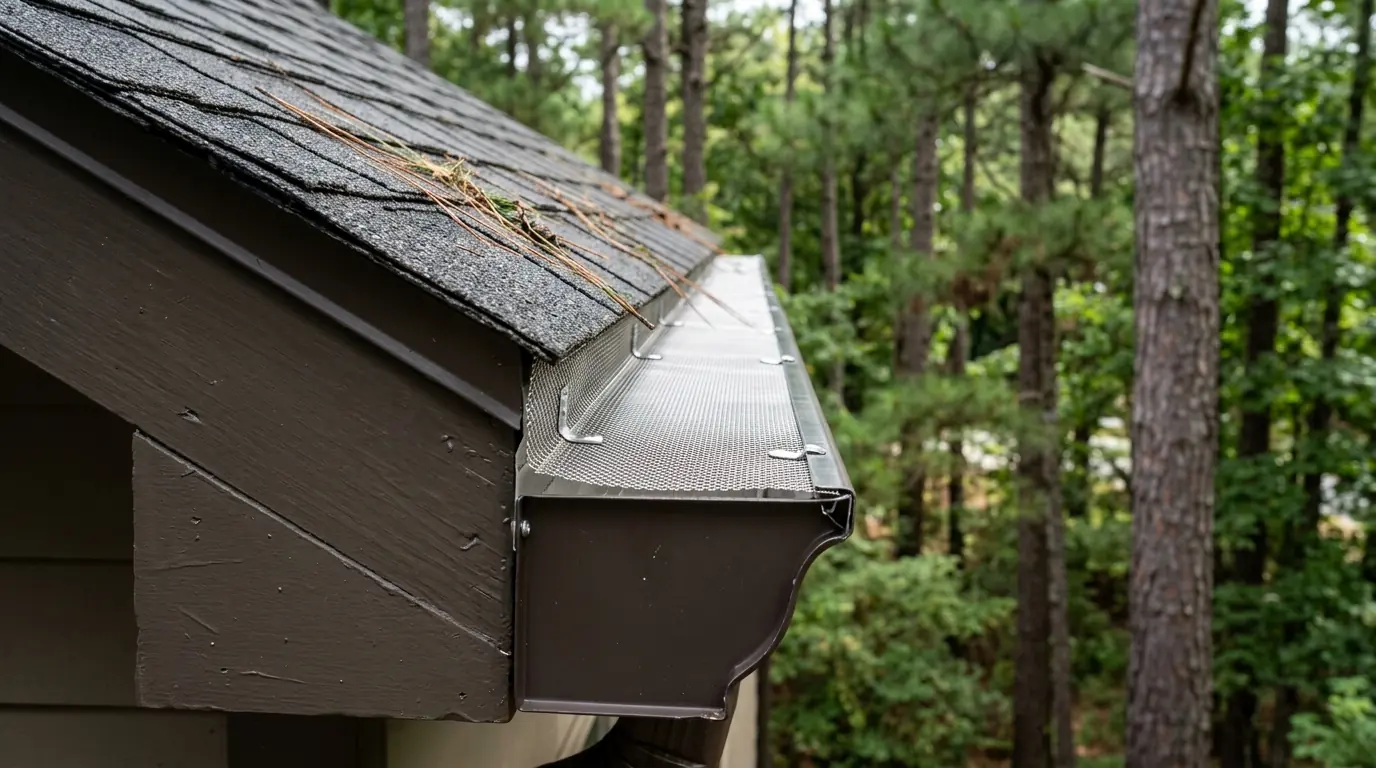
Micro-mesh guards use a fine stainless mesh stretched over a rigid frame, fine enough to keep out pine needles, oak tassels and seed pods while water sheets through. They are the right choice under pines and mixed canopy, which describes a lot of Atlanta. We fasten the frame to the gutter lip and slide the back edge under the drip edge or first course without prying up shingles, so the roof edge stays sealed. Expect an occasional brushing when pollen films over the mesh.
Screen and perforated guards
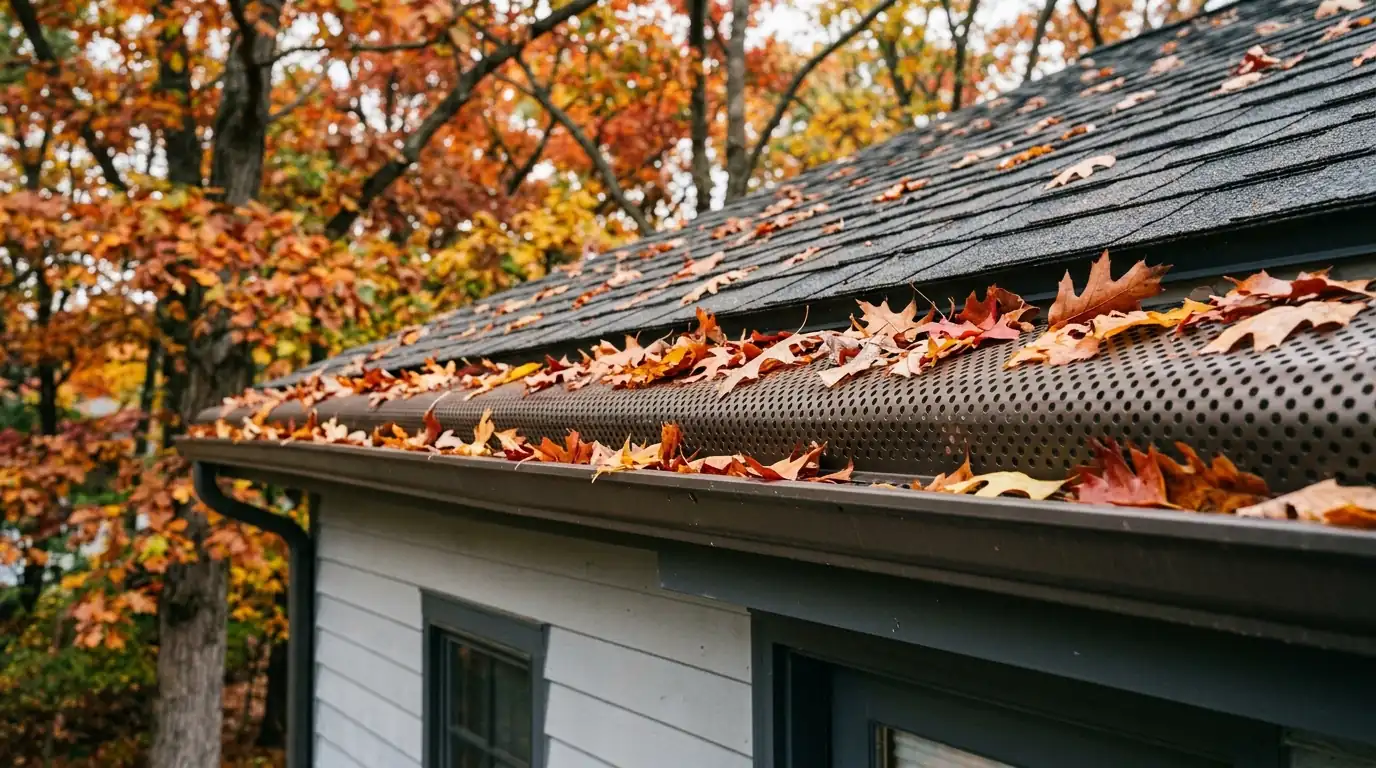
Screens and perforated metal covers cost less and work well under broad-leaf trees such as maples and oaks, where the debris is large enough to sit on top and blow off. They do not stop pine needles, which slip through and wedge in the openings. We use rigid, fastened versions rather than snap-in plastic screens, which sag, crack in the sun and blow out in storms. For homes with hardwoods only, this is the practical option, and it can be upgraded to mesh later on the same gutters.
Reverse-curve and solid-top guards
Reverse-curve covers wrap over the gutter and rely on water following the curved lip into a slot while leaves slide off the edge. They shed most leaves well and look clean from the street, but in the heaviest downpours water can overshoot the lip, and the inlet slot needs periodic cleaning. We install them on homes where the look matters and the roof pitch suits them, and we are honest when a steep roof or pine cover makes mesh the better call.

Storm debris and gutters in the metro
Summer storms do more than drop rain. The warning for the July 3, 2026 storm over Acworth called out wind damage to trees as well as roofs, and storms like that strip leaves, twigs and pine straw into gutters in one afternoon. A gutter that clogs in the middle of a storm overflows onto the fascia and the foundation, which is exactly when a guard earns its keep.
How it runs
How a gutter guard job runs
- 1
Check trees and roof edge
Debris type and roof edge assessed.
- 2
Recommend a guard
Matched to what falls on your roof.
- 3
Clean and repair
Gutters emptied, fixed and re-pitched.
- 4
Fit the guards
Cut, fastened and tucked at the roof edge.
- 5
Detail corners
Inside corners and outlets finished.
- 6
Water test
Flow checked with a hose.
FAQ
Gutter guard questions
No guard is. Good ones reduce cleanouts to an occasional rinse or brushing.
Micro-mesh. Pine needles slip through screens and wedge in the openings.
Usually, if the gutters are sound and pitched correctly. We repair them first when they are not.
Guards should go in without lifting or nailing through shingles. Check your shingle maker's terms; we install that way.
Mesh and screens handle most heavy rain. Reverse-curve covers can overshoot in the heaviest storms.
Yes. When gutters are worn out, replacing them and adding guards in one visit costs less than two trips.
Related
Gutter and roof edge work
Done clearing gutters every fall?
Call and we will look at your trees and roof edge and recommend the guard that fits.