Downspout drainage
Underground downspout drainage for Atlanta homes
Gutters only finish half the job. If the downspouts empty at the foundation, the water you caught on the roof soaks straight back into the ground next to the house. Buried drainage carries it away.
- Calls answered 24/7
- Sized for heavy rain
- Clay-soil experience
Quick answer
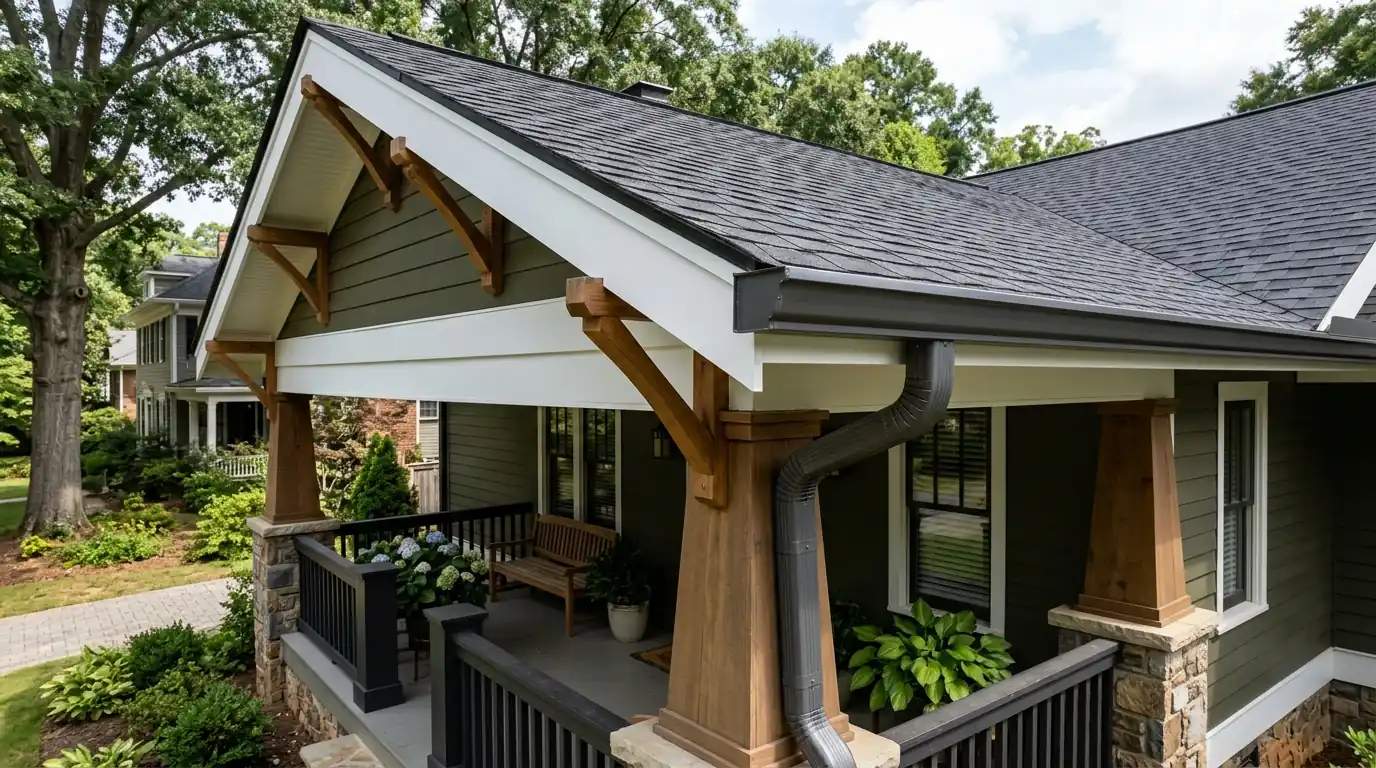
Underground downspout drainage in Atlanta means connecting each downspout to a buried solid pipe that slopes away from the house and empties at a pop-up emitter, a curb outlet where allowed, or a dry well. It keeps roof water out of crawl spaces and basements and stops erosion at the foundation. In Atlanta's red clay, which drains slowly, the outlet location and pipe slope matter more than anything else.
The work
Why downspouts cause foundation problems
A single downspout can carry hundreds of gallons in a hard summer storm, and if it empties onto a splash block a foot from the wall, most of that water ends up in the soil right against the foundation. Clay soil swells when wet and holds water against the wall, which is how crawl spaces stay damp and basements leak.
Burying the downspouts and carrying the water well away from the house fixes the problem at the source, and it gets rid of the extensions and splash blocks that get kicked aside and mowed over.
Updated September 2026
Options
Choosing where the water goes
| Factor | Pop-up emitter | Dry well | Curb or daylight outlet |
|---|---|---|---|
| Where water goes | Out at a low point in the yard | Soaks into gravel underground | To the street or a slope |
| Best for | Yards with some fall | Flat lots with no outlet | Lots that slope to the street |
| In clay soil | Works well with good slope | Needs sizing for slow drainage | Works well where allowed |
| Upkeep | Clear the lid occasionally | Keep the inlet clean | Keep the outlet open |
On most Atlanta lots, a pop-up emitter at a low point works best; a dry well is the fallback when there is nowhere for water to drain.
Cost
What underground downspout drainage costs depends on
Drainage is priced by the number of downspouts, the length of each run and the outlet you need.
- Number of downspouts
Each one tied into the system.
- Length of runs
Distance to a workable outlet.
- Outlet type
Pop-up emitters cost less than dry wells.
- Obstacles
Walkways, driveways and roots in the way.
- Soil and slope
Clay and flat lots need more work.
- Lawn restoration
Sod relaid or seeded after backfill.
What is included
What an underground drainage job includes
- Layout first. Each downspout traced to an outlet with fall.
- Trench dug. Sloped so water never sits in the pipe.
- Solid pipe. Smooth-wall or solid corrugated, not perforated near the house.
- Clean-out access. So the line can be flushed later.
- Outlet installed. Pop-up emitter, curb outlet or dry well.
- Water tested. Each downspout run before backfill.
- Lawn restored. Trench backfilled and the sod relaid.
Buried downspout extensions
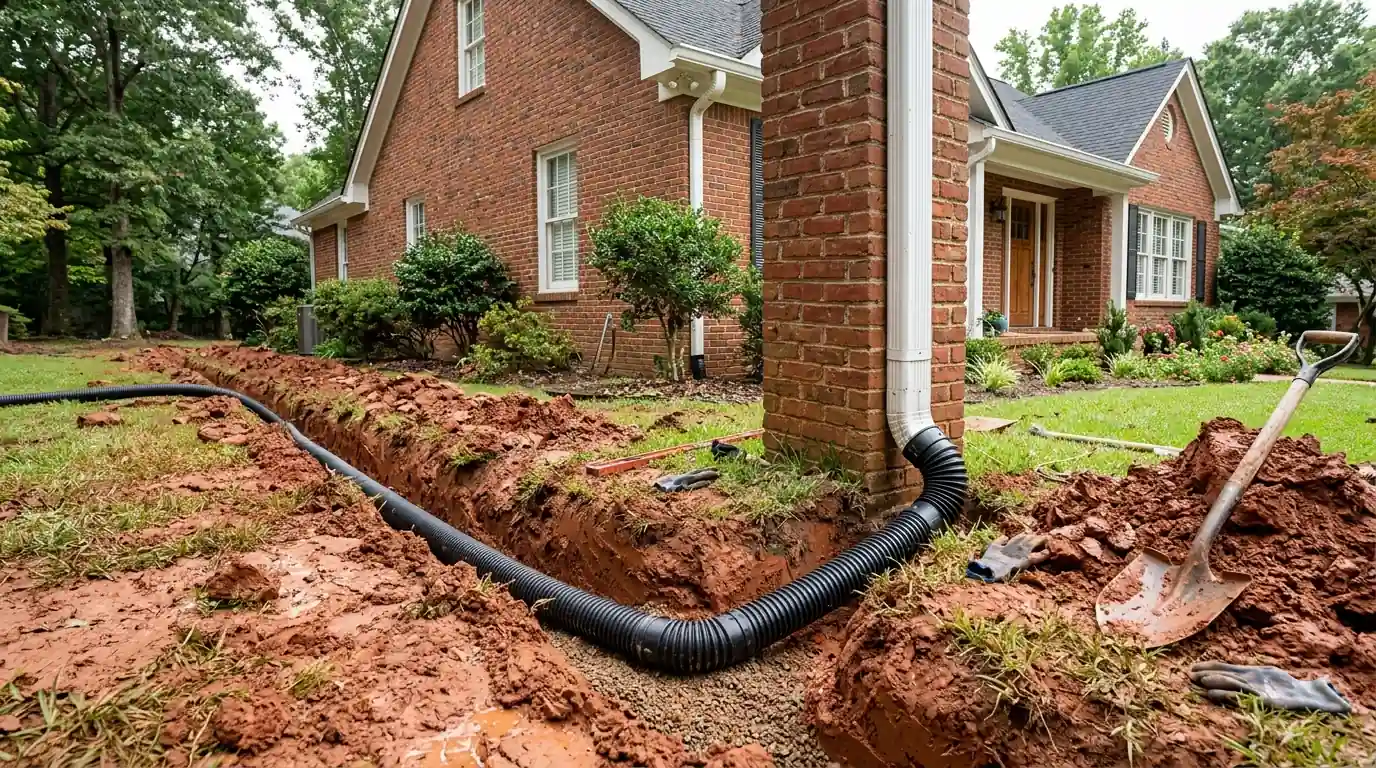
The simplest version runs each downspout into a buried solid pipe that slopes away from the house to an outlet ten or more feet out. We trace the route first so the pipe keeps a steady fall the whole way, because a line that dips will hold standing water and silt up. Near the foundation we use solid pipe, so water is not released where you are trying to keep it out. We add a clean-out so the line can be flushed, and connect the downspout with a fitting that does not leak.
Pop-up emitters and outlets
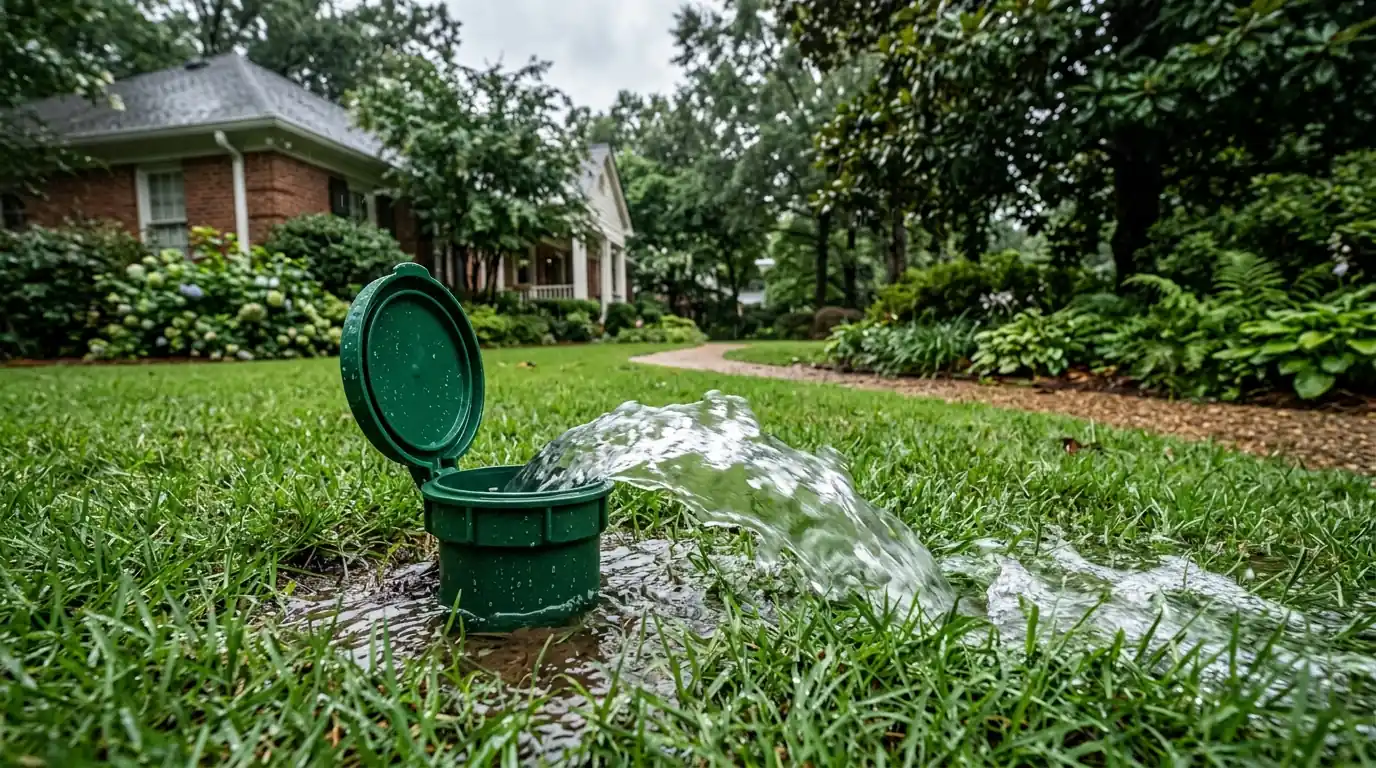
At the end of the line, a pop-up emitter sits flush with the lawn and opens when water pushes up, then closes so leaves and animals stay out. It works best at a low point in the yard where the water can spread out and soak in or run off. Where the lot slopes to the street or a ditch, a daylight or curb outlet can work instead, where local rules allow it. We pick the outlet by walking the lot in the rain if we can, not just by looking at a plat.
Dry wells and drainage repairs
On flat lots with nowhere for water to go, a dry well gives it somewhere to sit and soak in slowly. In Atlanta's clay, a dry well has to be sized generously because the soil drains slowly, and it should sit well away from the foundation. We also repair buried lines that have crushed, separated or filled with roots and silt. That is common on older homes, where the original drainage stopped working without anyone noticing and water quietly found the foundation again.
Atlanta's rules for rainwater on site
Inside the City of Atlanta, the Post-Development Stormwater Management Ordinance adopted in 2013 requires new homes and redevelopment to manage the first inch of rain on site with green infrastructure, which is why dry wells and other ways of soaking roof water into the ground show up on new construction. On existing homes, the goal is simpler: get roof water away from the foundation and into the yard, the curb or a well-sized dry well.
How it runs
How a drainage job runs
- 1
Walk the lot
Downspouts, slopes and low points mapped.
- 2
Plan the outlets
Emitter, curb outlet or dry well chosen.
- 3
Locate utilities
Underground lines marked before digging.
- 4
Trench and lay pipe
Solid pipe set with steady fall.
- 5
Test the flow
Water run through every line.
- 6
Backfill and restore
Trench closed and the lawn put back.
FAQ
Downspout drainage questions
If your downspouts empty at the foundation, yes. Gutters collect the water; the drainage decides where it ends up.
At least ten feet where the lot allows, farther on clay soil or where the yard slopes back toward the house.
A small cap at the end of a buried line that opens when water pushes up and closes afterward, sitting flush with the lawn.
They can, with leaves and roof granules. Gutter guards and a clean-out at each line make them easy to keep clear.
Yes. Underground utilities are located and marked before any trench is dug.
Yes. We locate, flush and repair crushed, separated or root-filled lines, or replace them.
Related
Gutter and drainage work
Water pooling at your foundation?
Call and we will walk the lot, find where the water should go, and plan the drainage.