Commercial repair
Commercial roof leak repair across Atlanta
A leak over inventory, a server room or a tenant's ceiling can't wait for a replacement budget. We find the entry point, make the repair, and tell you honestly how much life the roof has left.
- Calls answered 24/7
- Membrane and metal roofs
- Commercial buildings
Quick answer
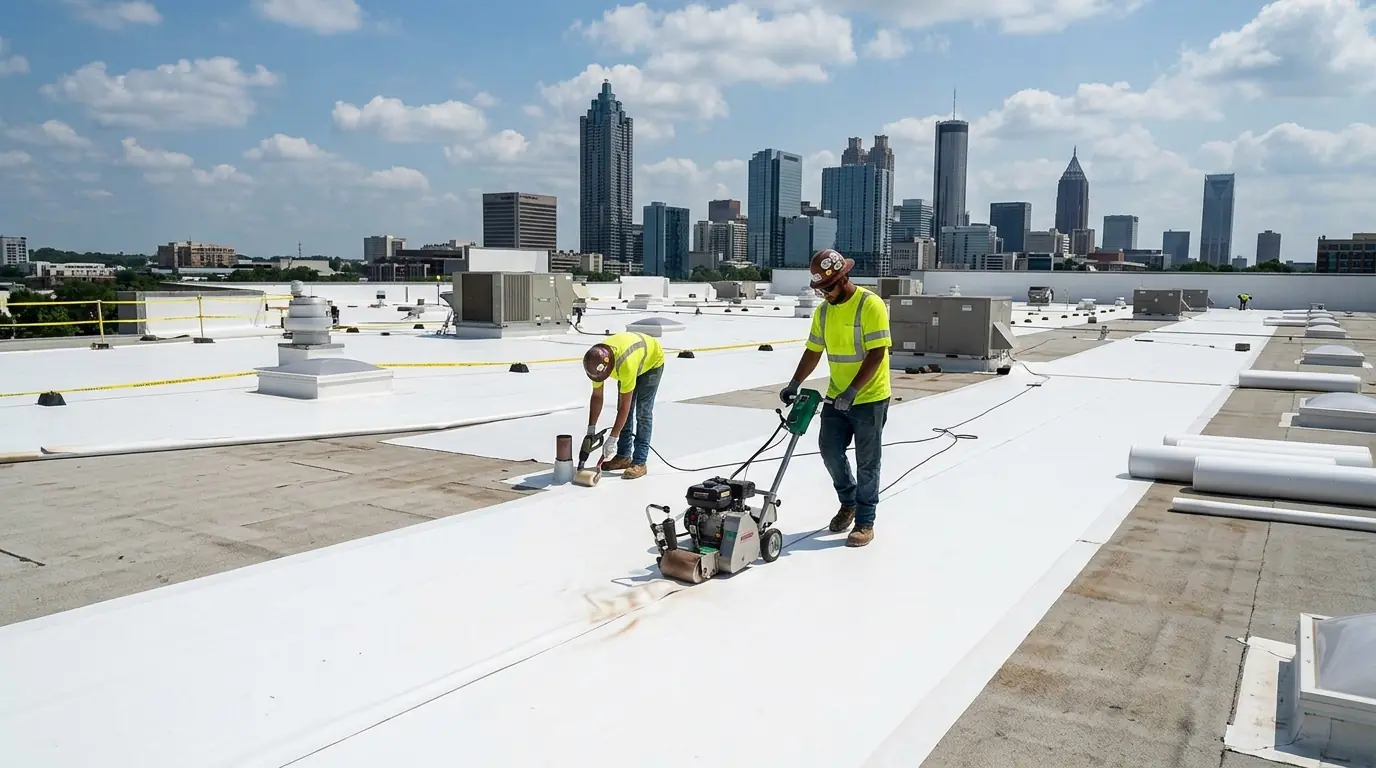
Commercial roof repair in Atlanta usually comes down to three failure points: open seams or punctures in the membrane, ponding around clogged or sunken drains, and failed flashing at curbs, pipes and walls. We trace the leak from inside and on the roof, repair it with the membrane's own system, and photograph the condition of the rest of the roof.
How it runs
How a commercial leak call runs
- 1
Call answered
Where it leaks, what is below, how urgent.
- 2
Trace from inside
Stain location, deck and ceiling checked.
- 3
Trace on the roof
Seams probed, penetrations and drains inspected.
- 4
Temporary seal if needed
Weather or wet conditions handled first.
- 5
Permanent repair
Matched to the roof system and probed.
- 6
Condition report
Photos of the rest of the roof and what it needs.
Warning signs
Signs a commercial roof needs attention now
Ceiling tile stains
Brown rings or sagging tiles below the roof.
Water standing for days
Ponding that outlasts the storm.
Bubbles or blisters
Moisture trapped under the membrane.
Open seams
Sheet edges lifting or split.
Loose edge metal
Coping or edge flashing moving in wind.
Rust at curbs
Corroded unit curbs and pipe flashings.
The work
Why commercial roofs leak where they do
The open field of a membrane rarely fails first. Water gets in at the details: a seam welded cold, a penetration an HVAC contractor added years later, a drain sitting above the roof around it, a wall flashing whose termination bar pulled loose. Finding the real entry point is most of the job, because water can travel yards under a membrane before it drips.
Repairs use materials that match the roof system, so the patch bonds instead of sitting on top.
Updated September 2026
Membrane seam and puncture repair
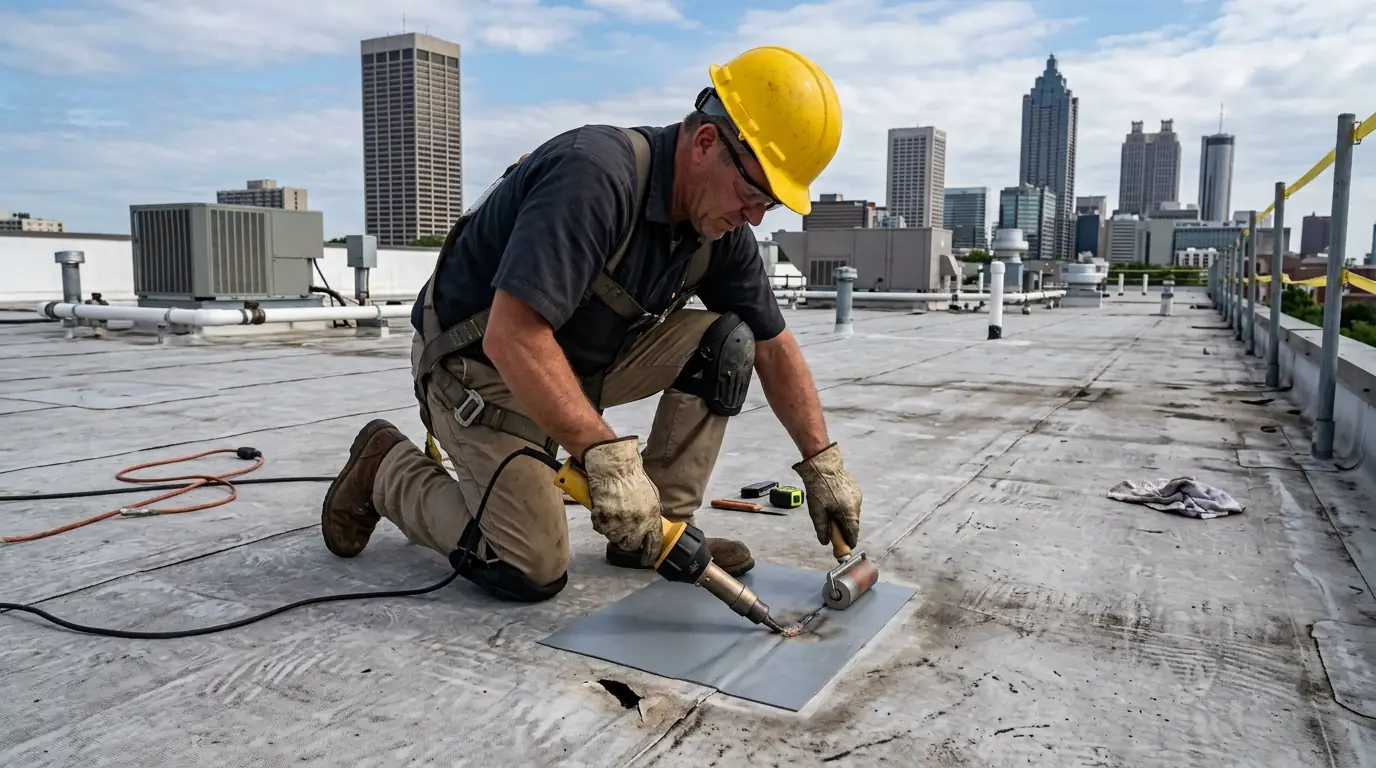
Seams open when a weld was made too cold or the adhesive let go, and punctures come from dropped tools, service traffic and hail. On TPO and PVC we clean the sheet and heat-weld a patch of the same membrane; on EPDM we prime and apply cured cover tape; on modified bitumen we heat-fuse a patch of cap sheet. Every repair is probed after it cools. If seams are failing across the whole roof, we will say so rather than chase them one at a time.
Ponding and drain repair
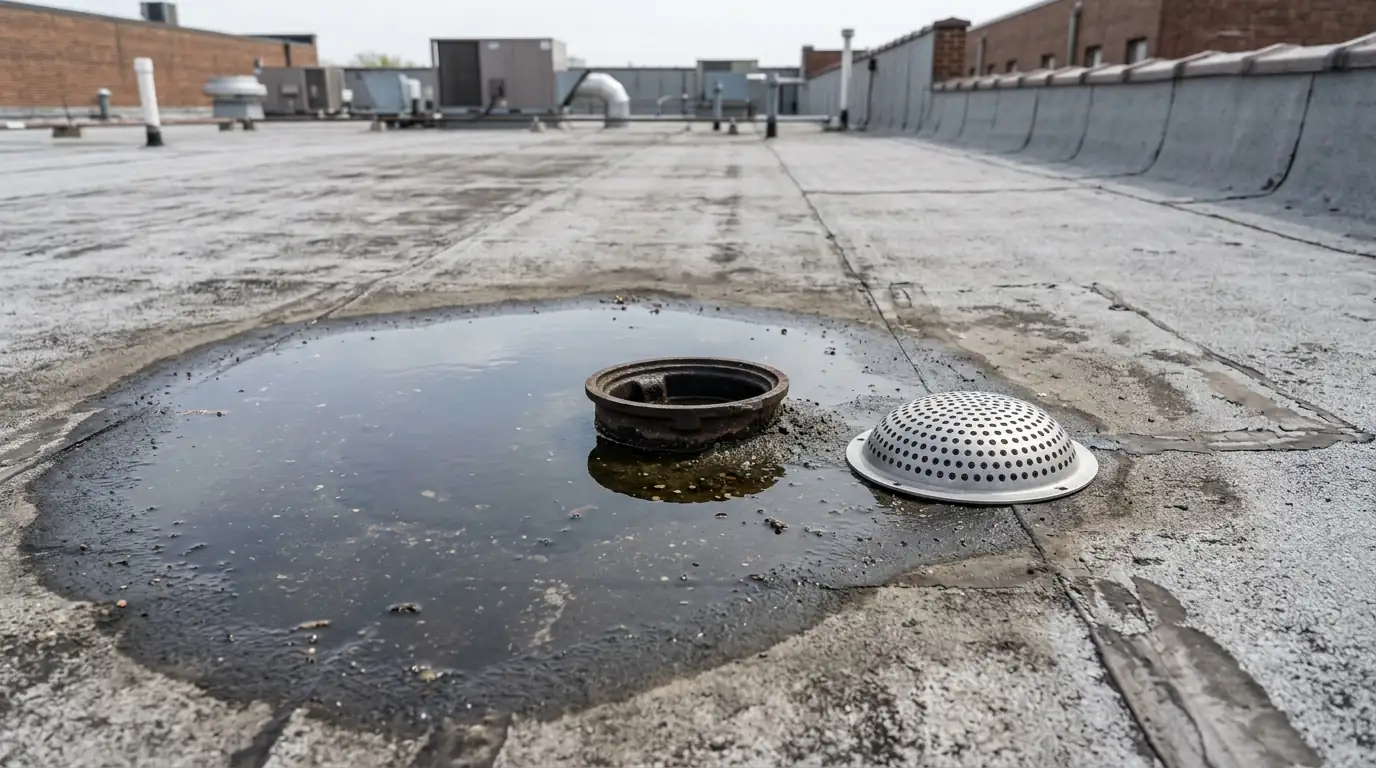
Water that stands for days after a storm adds weight, breaks down the membrane and finds any weak seam in the pond. The cause is usually a drain or scupper set too high, a clogged strainer, or a deck that sagged between joists. We clear and reset drains, add crickets or tapered insulation to steer water toward them, and replace sections of wet insulation that have crushed. Clearing leaves out of the strainers every spring and fall prevents many of these calls altogether.
Curb and penetration flashing
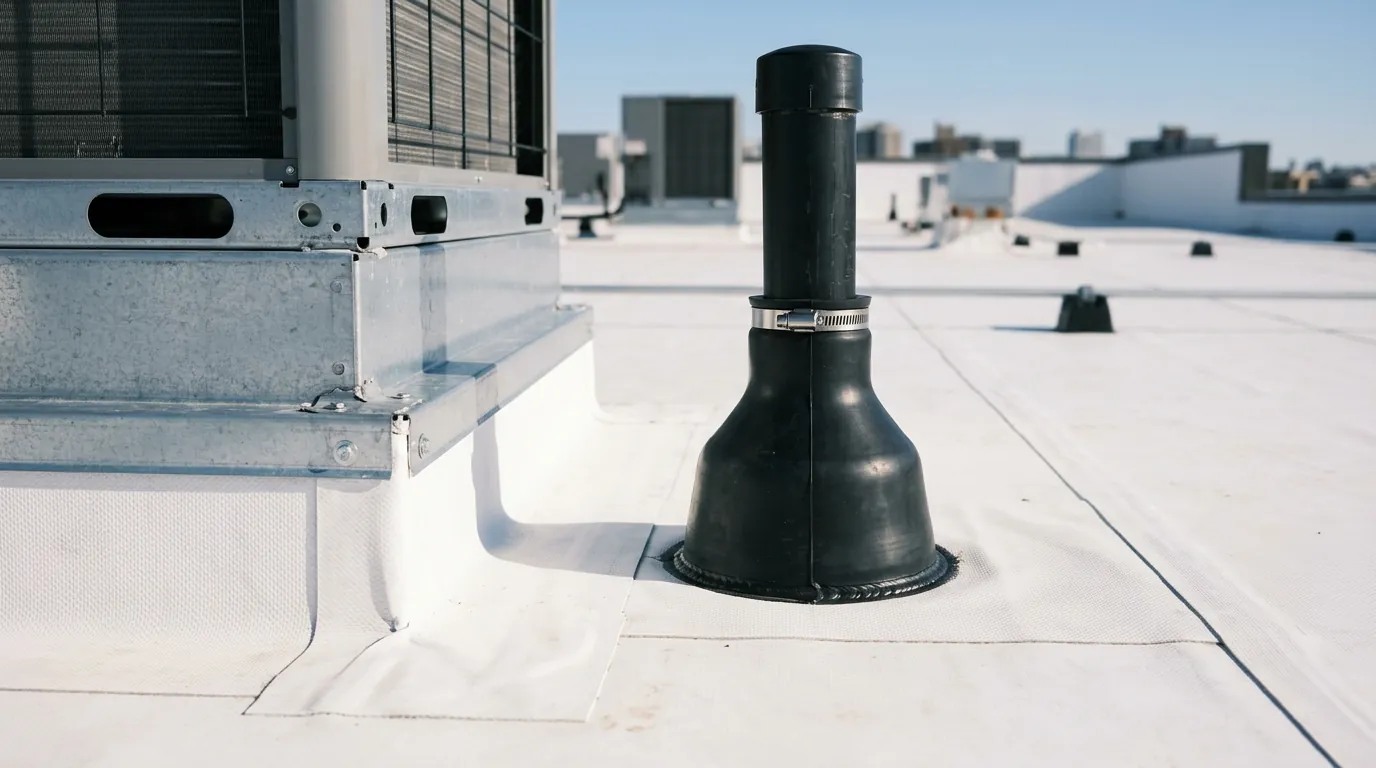
Every pipe, vent, conduit and HVAC curb is a hole in the roof, and these are where commercial leaks most often start. Pitch pans dry out and crack, curb flashing rusts, and penetrations added after the roof went on are often sealed with caulk alone. We flash them the way the membrane manufacturer details it, using prefabricated boots where they fit and new curb wraps where they do not, and we coordinate with your HVAC contractor when a unit has to be lifted.
Repairs, replacements and the city's roof rule
Most metro Atlanta commercial roofs are TPO or EPDM, so repairs here are mostly heat-welded thermoplastic or taped rubber, and matching the existing system matters more than the brand name on the patch. The city's cool-roof ordinance does not change that: it applies to full replacements and new construction, not repairs, so a patch on a black EPDM roof can stay black. The eventual replacement is what will need a reflective surface.
Timeline
How fast a commercial leak should be handled
Water under a membrane soaks the insulation, and wet insulation loses much of its value while adding weight to the deck. A leak left through a week of storms can turn a seam repair into a section replacement. Call when the stain first appears; we answer any hour, make a temporary seal if the weather is against us, and return for the permanent repair when the roof is dry enough to bond.
Cost
What affects a commercial repair price
Repairs are priced on what we find once the leak is traced, not by the call.
- Membrane type
Welded, taped or fused repairs differ.
- Wet insulation
Soaked sections cut out and replaced.
- Access
Roof hatch, ladder or lift needed.
- Number of leaks
One seam or several failure points.
- Penetrations
Curbs and pipes reflashed individually.
- Drain work
Resetting drains and adding crickets.
FAQ
Commercial roof repair questions
TPO, PVC, EPDM, modified bitumen and metal. Each is repaired with its own materials so the patch bonds.
We start at the stain inside, then check seams, penetrations and drains upslope of it. Water can travel far under a membrane before it drips.
Water that stands more than a couple of days stresses seams and adds weight. It usually points to a drain or slope problem worth fixing.
Repair when failures are isolated and the insulation is mostly dry. When seams fail across the roof or insulation is wet over large areas, replacement costs less long term.
Yes. Most repairs happen on the roof, with no disruption inside beyond checking the leak location.
Yes. Clearing strainers in spring and fall prevents many ponding leaks, especially under trees.
Related
Other commercial roof services
Commercial Roof Maintenance
Scheduled roof inspections, drain and debris clearing and more.
Learn moreCommercial Roof Inspection
Covers moisture surveys and core cuts and post-storm and insurance inspections.
Learn moreCommercial Roof Installation
Metal commercial roofing, plus tpo and pvc single-ply.
Learn moreLeak over your business?
Call any hour. We trace it, stop it, and tell you straight what the rest of the roof needs.