Guide
Gutter sizing for Atlanta rain: when 5-inch gutters are not enough
Most gutters that overflow in Atlanta are not clogged and not broken. They are simply too small for the roof above them, or they drain into too few downspouts.
- Calls answered 24/7
- 5-inch or 6-inch
- Downspout sizing
Quick answer
For most Atlanta homes, 5-inch K-style gutters are enough on modest roofs with average pitch, but large or steep roofs, long gutter runs and valleys that dump water into one corner usually call for 6-inch gutters and 3x4 downspouts. Atlanta gets more than 50 inches of rain a year, often in short, heavy summer storms, so gutters need to handle the peak rate, not the average.
- Why gutter size matters here
- Roof area and pitch set the load
- 5-inch or 6-inch gutters
- Downspouts are the bottleneck
- Valleys, trees and inside corners
- Where the water goes next
Why gutter size matters here
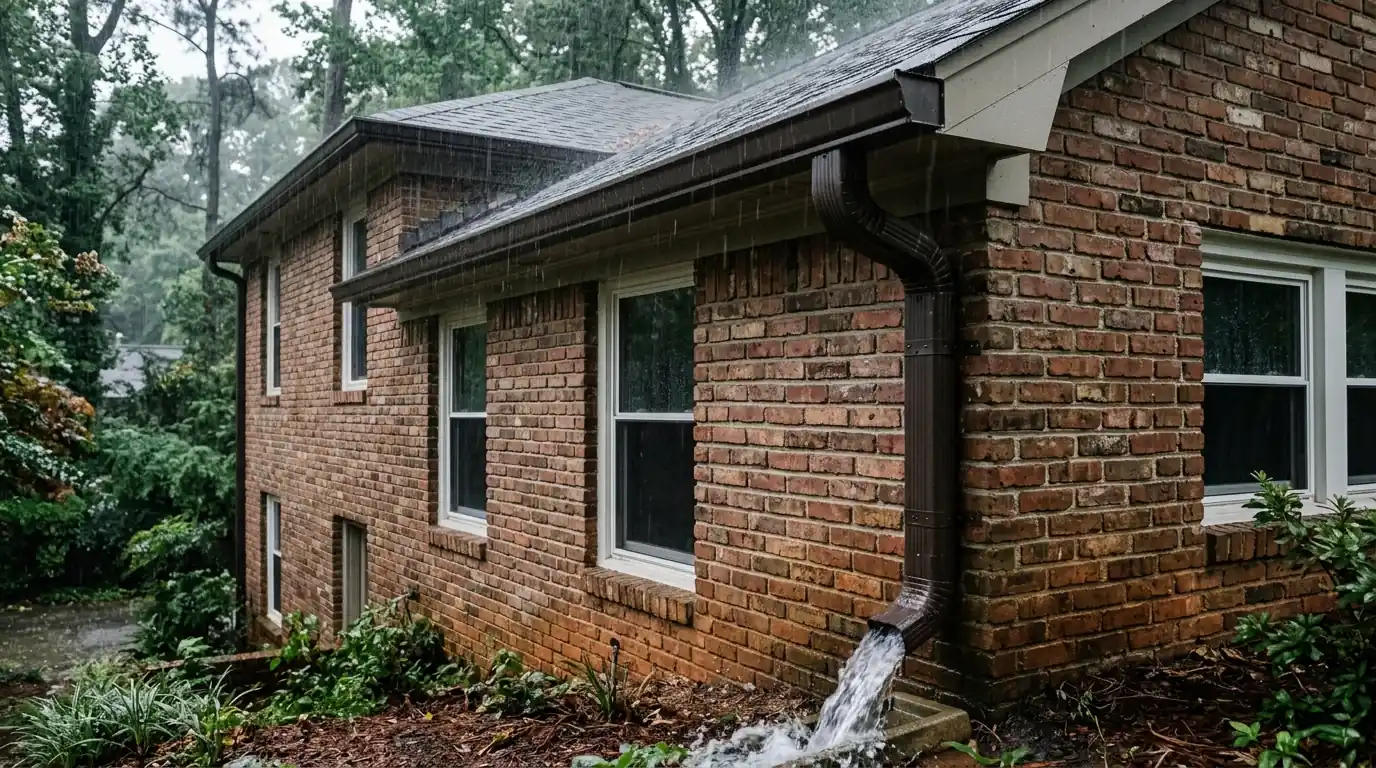
Atlanta's climate delivers more than 50 inches of rain a year, and much of it arrives in short, heavy summer storms. Gutters are sized for the peak rate of water coming off the roof during those storms, not for the yearly total, and a gutter that handles a steady shower can still overflow in a ten-minute downpour.
When gutters overflow, water lands right along the foundation and splashes back onto the siding and trim, which is exactly what gutters are supposed to prevent. Undersized gutters also pull loose under the weight of the water they hold.
Roof area and pitch set the load
The water a gutter has to carry comes from the roof area that drains into it. A long, wide back slope can send several times as much water into one gutter run as a short front slope, and the bigger the area, the bigger the gutter and the more downspouts it needs.
Pitch matters too. Steep roofs shed water faster and throw it toward the outer edge of the gutter, so a steep roof of the same size needs more gutter capacity than a low-pitched one. On very steep roofs, water can overshoot a small gutter entirely in heavy rain.
5-inch or 6-inch gutters
Five-inch K-style gutters are the standard on most homes and are enough for modest roofs with average pitch and plenty of downspouts. Six-inch gutters carry considerably more water and are the better choice on large two-story homes, steep roofs, long runs and any run that collects water from a valley.
Six-inch gutters cost more and look slightly heavier on a small house, so they are not automatically better. The right answer comes from the roof area, pitch and downspout layout on each run.
Downspouts are the bottleneck
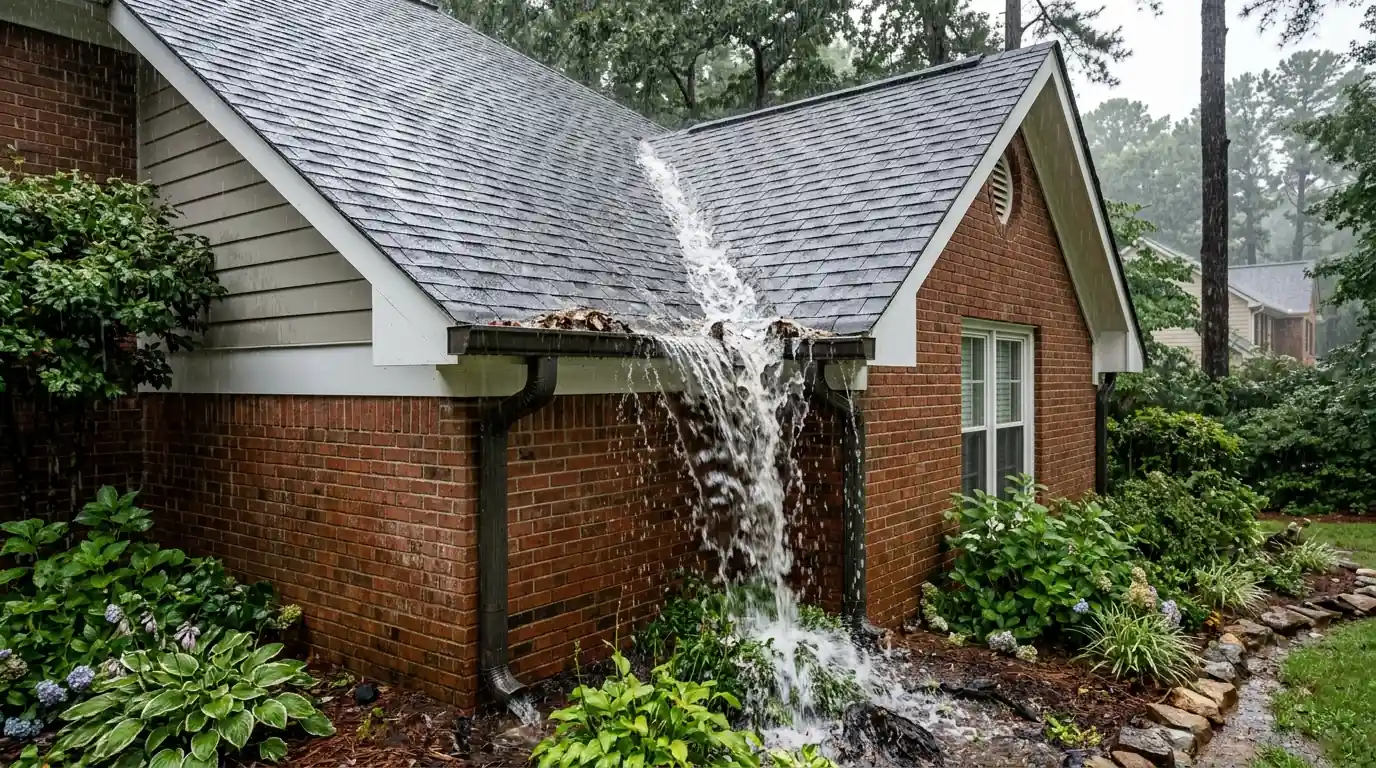
A gutter can only drain as fast as its downspouts, and many overflow problems are really downspout problems: too few outlets, outlets placed far from where the water lands, or 2x3 downspouts on runs that need 3x4. A 3x4 downspout carries far more water than a 2x3 and clogs less easily.
As a working rule, long runs need a downspout at each end, and any corner that collects water from a valley needs an outlet close to it. Where the roof drains into a single corner, a larger downspout there often solves what a bigger gutter would not.
Valleys, trees and inside corners
Roof valleys concentrate water from two slopes into one narrow stream, and where a valley ends above an inside gutter corner, the water often shoots past the gutter in a downpour. A valley splash guard, a larger gutter at that corner, or an extra downspout close by keeps that water in the system.
Atlanta's tree cover adds debris, and debris effectively shrinks a gutter. Larger gutters and downspouts clog less easily, and guards help, but sizing still has to assume the gutters will sometimes be partly full.
Where the water goes next
Once the water is in the downspout, it has to leave the house. Splash blocks a foot from the wall still put a lot of water against the foundation in heavy rain, so many Atlanta homes benefit from extensions or buried lines that carry it well away.
Inside the City of Atlanta, new homes and redevelopment must manage the first inch of rain on site, which is why dry wells and similar systems appear on newer construction. On existing homes, the aim is simply to move the water away from the walls.
Gutters overflowing in heavy rain?
Call and we will look at the roof area, the pitch and the downspouts before recommending a size.
Call (470) 802-9803FAQ
Related questions
They carry more water and suit large, steep roofs and long runs. On a modest roof with enough downspouts, 5-inch gutters do the job.
Usually because they are undersized for the roof area, the downspouts are too small or too few, or a valley dumps water into one corner.
3x4 downspouts carry far more water than 2x3 and clog less easily, and they are the better choice on most larger Atlanta homes.
Often, yes. Adding an outlet near a valley or at the far end of a long run solves many overflow problems without new gutters.
No. Guards keep debris out, but sizing should still assume heavy rain and some debris on the guards.
Keep reading
More roofing guides for Atlanta homeowners
Hail Damage Signs on Atlanta Roofs
What to check from the ground after hail, and what a close inspection finds.
Read the guideHow long an Atlanta roof really lasts, and what shortens it
Typical lifespans by material, what Atlanta weather does to them, and end-of-life signs.
Read the guideRoof leaking in a storm: first steps
The first steps to protect your home, when to call for a tarp, and how to document damage for a claim.
Read the guideNeed gutters that keep up with Atlanta rain?
Call and we will size the gutters and downspouts to your roof before quoting.